The main referee speaks only Japanese: commands, announcements of points and fouls, decision. Here are the words heard at the edge of the mat, grouped by moment of the bout, with what the rulebooks say about them.
↑↓move↵openescclose
Type at least two letters. Arrow keys move through the questions, Enter opens the chosen question, Escape closes the list.
Bows and commands
From the opening bow to the final “yame”, what the main referee orders.
Red and white: the two competitors. Aka is the competitor with the lower bib number, on the left seen from the front; shiro, with the higher number, on the right. The judges raise the flag of the colour of the competitor they designate.
“Begin”: the bout starts on this command from the main referee; so does the clock. The EKO rules specify that the referee marks the start with a gyaku-zuki gesture.
“Stop”: the bout stops at once. The main referee orders it to announce a point, a foul, a jogai, to separate the competitors, to tidy a dogi, or to end the bout. A jogai takes effect on “yame”.
“Continue”: the bout resumes after a stop, and it is the order to attack when the competitors just stand and look at each other. Failing to engage promptly after “zokko” is a foul (WKO 2026).
“Corner judges, gather”: the main referee calls the four judges together to deliberate, for instance before a chui 2 or a disqualification for a single foul, or when a judge asks for a second opinion.
SourcesEKO 2019 — art. 5.4; art. 17.6, p. 17 · WKO 2026 — Refereeing gestures, d and k
The competitor's answer. Under the EKO rules, the penalised competitor must say “Osu!” when his foul is announced; at tameshiwari, one bows saying “Osu”.
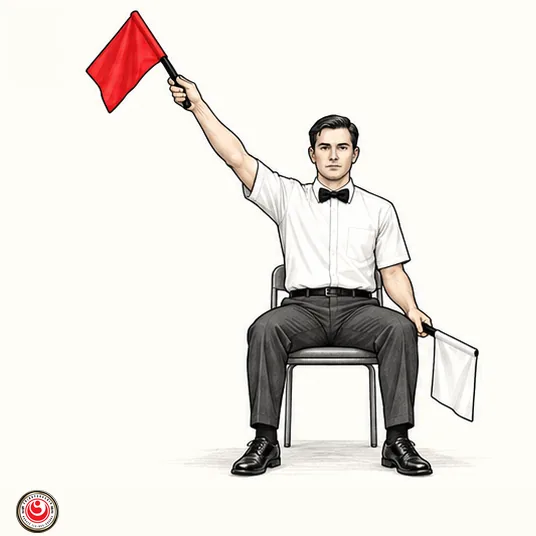
Full point: immediate win. A permitted technique after which the opponent stays down or loses the will to fight for three seconds or more, or two waza-ari. Flag raised diagonally, long whistle.
SourcesWKO 2026 — Ippon; refereeing gestures, a · EKO 2019 — art. 17.5, p. 15
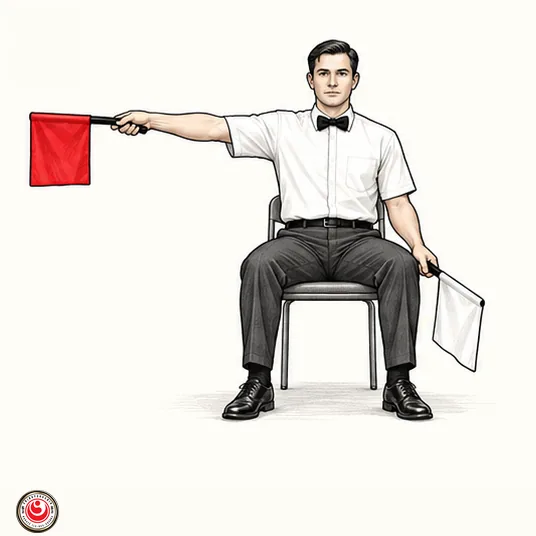
Half point: a fall or loss of the will to fight with recovery in under three seconds, damage with loss of balance, or a sweep followed by a gedan-zuki. Flag held horizontally.
SourcesWKO 2026 — Waza-ari; refereeing gestures, b · EKO 2019 — art. 17.5, p. 15
“Effective technique”: a permitted strike that causes damage. If it prevents the opponent from continuing, the opponent loses (doctor's stop); without a point, the number of effective strikes weighs in the decision.
Decision of the judges, when there is neither ippon nor disqualification. WKO 2026 priorities: the waza-ari, then damage, then the number of punches and kicks, then fighting spirit. Three votes out of five are needed.
“We take the decision”: the main referee announces that he will ask for the judgment, then says “hantei”; the judges then raise their flag with a whistle.
SourcesWKO 2026 — Refereeing gestures, i; end of the bout · EKO 2019 — art. 17.6, p. 18
One, two, three, four, five: the main referee counts the flags aloud, his own included, starting with the less numerous colour. Example: “hikiwake ichi, ni — aka ichi, ni, san: aka”.
SourcesWKO 2026 — End of the bout, examples · EKO 2019 — art. 17.6, p. 18
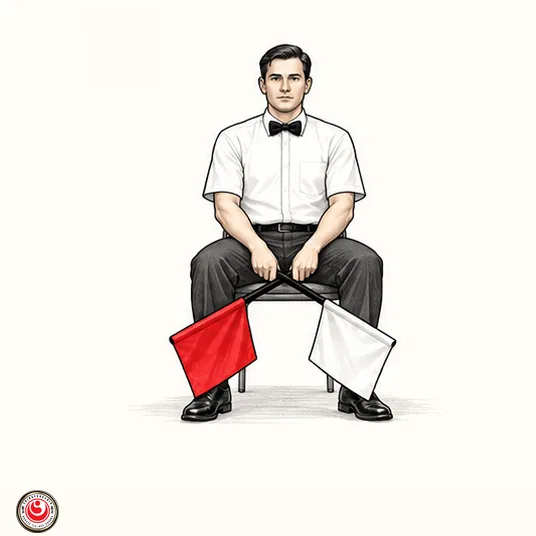
Draw: fewer than three votes for either competitor. Flags crossed in front of the knees; the referee crosses his arms downwards. An extension follows, then the decision by weight.
Extension. After a draw, a first extension; then, depending on the rules, a further extension (sai encho-sen), the weigh-in, and the final extension (saishu encho-sen), where a winner must be named.
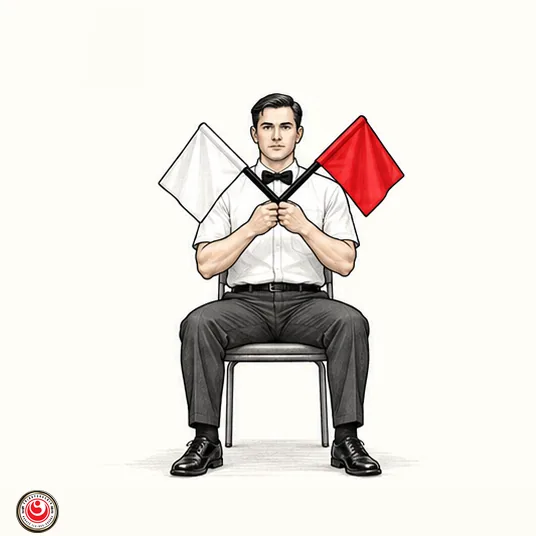
“Not seen”: the corner judge crosses the flags with a short whistle; the bout goes on. Under the WKO 2026 rules, if three or more judges signal “miezu” on a fall, the main referee asks for the video check (VAR). The EKO says “fumei”.
SourcesWKO 2026 — Refereeing criteria, 3; refereeing gestures, g · EKO 2019 — art. 17.5, p. 15
Fighting spirit. Last decision criterion of the WKO 2026 rules: with an equal number of techniques, the competitor with the superior fighting spirit wins, when a decision must be made in the final extension.
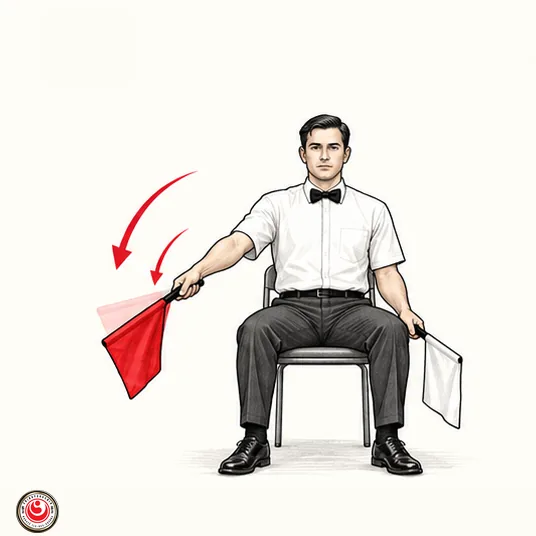
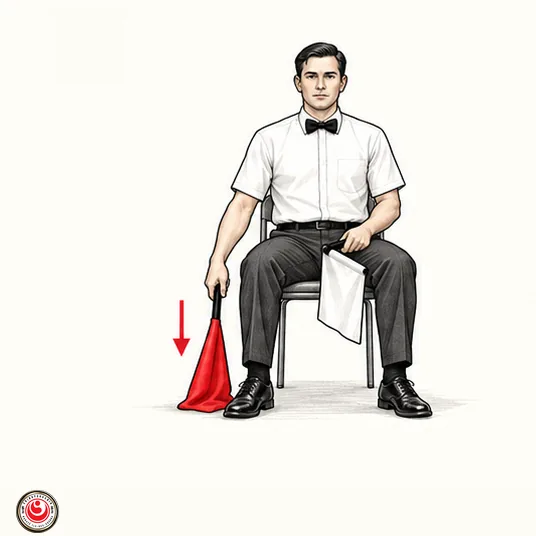
Foul. The corner judge waves the offender's flag downwards with short whistles; the main referee announces the colour, counts, names the foul and gives the warning. Hansoku-make: loss by foul (chui 4).
Warning. WKO 2026: chui 1 for a foul, chui 2 possible at once for an intentional or malicious foul, disqualification at chui 4. The referee points his forefinger at the offender: “chui ichi” (1), “chui ni” (2).
SourcesWKO 2026 — Chui 1 and chui 2; refereeing gestures, d · EKO 2019 — art. 13
Penalty, in the EKO rules: two chui make “awasete genten ichi”, two penalties (genten ni) mean disqualification. The referee points his forefinger at the face; two fingers for genten ni. The WKO 2026 rules count in chui only.
Disqualification. The main referee raises his arm on the disqualified competitor's side and points outside the area. Grounds: chui 4 (genten ni under the EKO), disobedience, lateness or absence, violence, one minute face to face without fighting.
Push, with the palm (shotei), the fist, the head or the body; even with one hand. Pressing with both arms on the opponent's arm is also a foul; one hand on the forearm is allowed (WKO 2026).
Out of the area: both feet entirely outside the line. The judge taps the floor with the flag; the referee says “yame”, “jogai”, brings the competitors back to the centre and restarts with “zokko”. Repeatedly stepping out to flee is a foul.
SourcesWKO 2026 — Jogai; fouls, p; refereeing gestures, f · EKO 2019 — art. 9.14; art. 17.5, p. 15
Techniques named in the rulebooks
The names the referee says when announcing a point, and the body parts the rulebooks name.
Kick. Mae-geri (front), mawashi-geri (roundhouse: jodan to the head, chudan to the body, gedan to the thigh), ushiro-geri (back), yoko-geri (side), kakato-geri (heel), hiza-geri (knee): dojo vocabulary; the rulebooks cite mae-geri, mawashi-geri and do-mawashi kaiten-geri.
SourcesWKO 2026 — Ippon and waza-ari · EKO 2019 — art. 17.6, pp. 18-19
Elbow strike. Can score to the body; prohibited to the face, the neck, and downward onto the shoulder or collarbone. Hiji is also one of the breaking techniques.
SourcesWKO 2026 — Ippon and waza-ari; fouls, a and t · EKO 2019 — art. 16.5
Board-breaking test, which decides certain bouts (EKO open category, finals of some tournaments). Four techniques under the EKO: seiken, sokuto, hiji, shuto.
Failed break. The official crosses his arms and waves them sideways. After a first failure, a second attempt at the minimum number of boards; a further failure scores zero.
Doctor's stop: proposed by the tournament doctor when a competitor can no longer continue, declared by the referees after deliberation. After a foul technique, the offender loses; after an effective technique, the injured competitor loses.
Common technique names (mae-geri, mawashi-geri…) are the dojo's vocabulary; refereeing words point to the texts. Spellings follow the rulebooks (zokko, hantei, shikkaku); zokkou and shikaku are also seen. The six flag-signal drawings are original drawings by the dojo (2026), made from the rulebooks' descriptions; they do not replace their text.
He stops the bout with “yame”, announces the colour of the waved flags, counts them aloud including his own, names the foul, points his forefinger at the offender and declares “chui ichi”. EKO example: “aka — ichi, ni, san, shi, go — tsukami, chui ichi”. The competitor answers “Osu!”.
Sources for this answerWKO 2026 — Refereeing gestures, d · EKO 2019 — art. 17.6, p. 18
In the same way: “yame”, colour of the raised flags, count, name of the technique, then the arm raised diagonally for “ippon” or horizontally for “waza-ari”. EKO example: “aka — ichi, ni, san, shi, go — jodan mawashi-geri, ippon”.
Sources for this answerWKO 2026 — Refereeing gestures, a and b · EKO 2019 — art. 17.6, p. 19
Shomen ni rei (to the front, the official table), shushin ni rei (to the main referee), otagai ni rei (to each other). The same three bows open and close the bout; then “kamaete” and “hajime”.
Sources for this answerWKO 2026 — Refereeing gestures, start of the bout; end of the bout · EKO 2019 — art. 17.5
The other topics
The twelve rules topics, in questions and answers.
Every answer cites its text. The rulebooks belong to their organisations; when in doubt, the official document prevails.
WKO2026RegulationWKO Competition Rules (全世界空手道連盟 試合規約), revised edition of 29 July 2026 — Japanese text, unofficial translationOfficial document Official page
EKO2019RegulationEKO — Kumite Competition Regulation and Rules (17 March 2019)Official document
Unofficial translation from Japanese (Claude, for the dojo, October 2026); the original text prevails.
From the rulebook to the mat.
Rules are there to be understood; the rest is learned at the dojo on Nuns’ Island, with a free first class.